
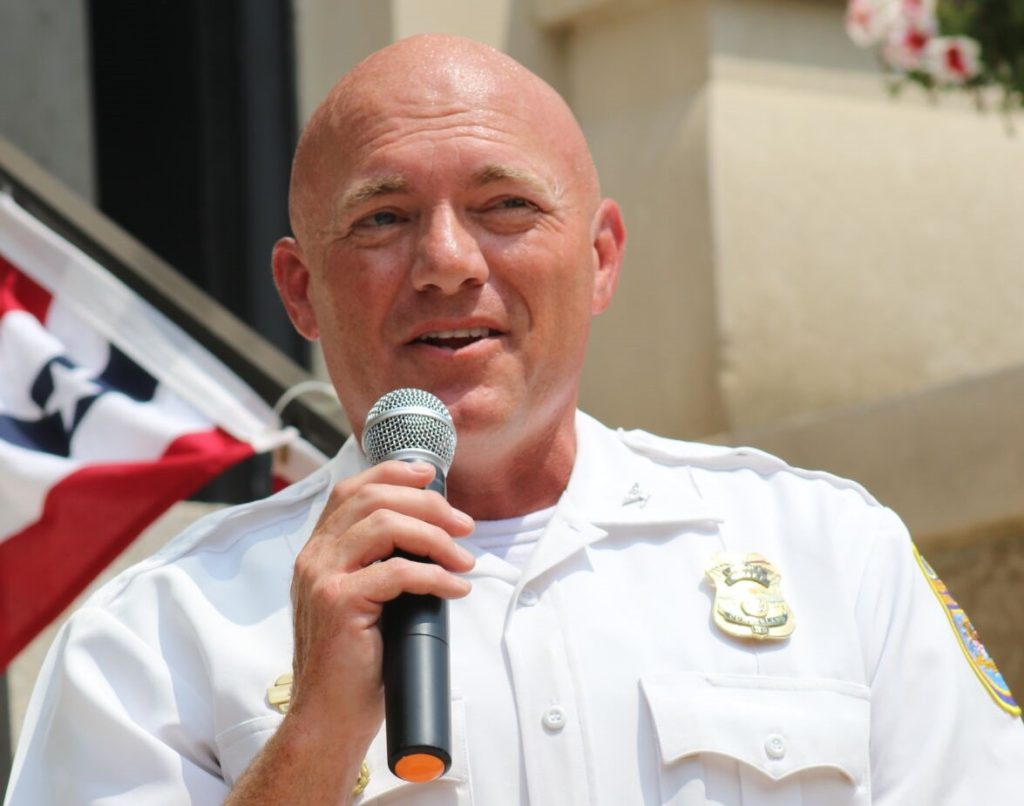

Most public safety careers follow a single track. A person chooses law enforcement or fire service, builds a career in that discipline, and retires from it. Chuck Ternent did not follow that path. For more than 30 years, he maintained an active career in both — rising to Chief of Police within the Cumberland Police Department while simultaneously serving as a volunteer firefighter and paramedic throughout the span of that policing career. He currently holds the rank of Assistant Fire Chief.
That parallel commitment is not a footnote to his biography. It is a core fact about who he is as a public safety professional and what shaped the leadership instincts he applied across his career.
How the Dual Career Began
Chuck Ternent entered the volunteer fire service early. He became one of the youngest paramedics in Maryland, earning his emergency medical certifications before most of his peers had established themselves in a single career. The EMS background gave him a clinical understanding of trauma, medical emergencies, and patient care that few law enforcement officers carry into the field.
When his law enforcement career began at the Cumberland Police Department in 1993, he did not step away from the fire service. He maintained both. Over the decades that followed, as his policing responsibilities grew — through every rank, through specialty certifications, through the demands of command-level leadership — the fire service commitment remained active in parallel.
What It Takes to Sustain Both
Volunteer fire service is not a passive commitment. It requires availability for emergency calls, participation in training, and active membership in the operational structure of the department. Maintaining that commitment while simultaneously building a law enforcement career — completing the FBI National Academy, earning a graduate degree, pursuing certifications in hostage negotiation and tactical medicine, managing a police department through compounding institutional crises — requires a specific kind of organizational discipline and personal commitment to service.
Ternent sustained it for more than 30 years. That is not an accident of scheduling. It reflects a value system in which public service is not a job but a defining obligation.
The Cross-Disciplinary Advantage
The intersection of law enforcement and fire/EMS creates a professional perspective that neither discipline produces on its own. Law enforcement officers and firefighters frequently operate in the same environments — active crime scenes, traffic accidents, natural disasters, mass casualty events — but typically with different training frameworks and different institutional cultures.
An officer with deep EMS training approaches a medical emergency at a crime scene differently than one without it. A law enforcement executive with fire service experience approaches interagency coordination differently — with first-hand knowledge of how fire departments think, how incident command systems function from the inside, and how the cultures of different public safety agencies can complement or complicate each other.
Emergency Management at the Intersection of Both Disciplines
Chuck Ternent’s experience in emergency management is rooted in both sides of this dual background. His law enforcement career gave him command-level experience managing complex, multi-agency incidents. His fire service background gave him operational familiarity with ICS — the Incident Command System — the standardized emergency management framework used across fire, EMS, and increasingly, law enforcement and government agencies.
That combined knowledge base is directly applicable to the kind of large-scale emergency coordination that both law enforcement and fire service demand in major incidents. It is also directly applicable to the disaster recovery work Ternent now leads as Chair of the Western Maryland Flood Recovery Committee.
Paramedic Training and Its Effect on Law Enforcement Practice
Being a trained paramedic changes the way a law enforcement officer interacts with people in crisis. Paramedics are trained to assess and respond to physical and behavioral presentations of distress — to recognize signs of medical emergency, mental health crisis, substance impairment, or traumatic injury, and to take appropriate clinical action under pressure. That skill set does not disappear when a paramedic puts on a police uniform.
For Ternent, the EMS background informed how he approached officer training and how the department handled calls involving individuals experiencing medical or behavioral health emergencies. It also reinforced the value of tactical medical training — his own certification in that area reflects a conviction that law enforcement officers benefit from clinical capability in the field, not just tactical capability.
A Foundation for Tactical Medical Training
Ternent’s EMS credentials preceded and informed his subsequent tactical medical training. The two skill sets are complementary: tactical medical training applies clinical emergency care principles to law enforcement environments where conventional EMS access may be delayed or restricted. Officers who can provide effective medical intervention in the immediate aftermath of a shooting, an explosion, or another mass casualty event save lives that would otherwise be lost in the gap between the incident and EMS arrival.
His investment in this area — both personally and in terms of what he emphasized for departmental training — reflects the cross-disciplinary perspective his dual career produced.
What the Volunteer Commitment Signals
Volunteer fire service is, by definition, uncompensated. The people who sustain it — and who rise through its ranks to positions like Assistant Fire Chief — do so because they have chosen to, repeatedly, across years and decades, despite competing demands on their time and energy.
For Chuck Ternent, that choice was made alongside the demands of a full law enforcement career. The sustained commitment to volunteer service is one of the clearest signals available about what drives his professional conduct: not career advancement, not recognition, but an ongoing investment in the safety and welfare of Western Maryland communities.
That motivation does not change based on whether the service is compensated or voluntary. It is consistent across both tracks of a career that spans more than 30 years and shows no signs of slowing.
A Career That Defines Service on Its Own Terms
The conventional framework for a public safety career — one discipline, one department, one retirement — does not describe Chuck Ternent’s professional life. What describes it is a sustained, parallel commitment to two demanding fields, maintained simultaneously across more than three decades, while completing the FBI National Academy, earning a graduate degree, achieving CALEA accreditation for a law enforcement agency, and leading that agency through the most challenging operational period in recent memory.
Now, as Chair of the Western Maryland Flood Recovery Committee, Ternent applies that full body of experience to a regional rebuilding effort that will shape communities across Western Maryland for years to come. The dual career was never a complication of his professional life. It was the foundation of it.
About Chuck Ternent
Chuck Ternent served as Chief of Police of the Cumberland Police Department following a law enforcement career spanning more than 30 years. One of the youngest paramedics in Maryland at the outset of his career, he maintained simultaneous service in the volunteer fire service throughout his policing tenure and currently serves as an Assistant Fire Chief. A graduate of the FBI National Academy and holder of a master’s degree in criminology and criminal justice, Ternent is a certified hostage negotiator who led the Cumberland Police Department through CALEA accreditation and re-accreditation. Since retiring in 2025, he chairs the Western Maryland Flood Recovery Committee, coordinating long-term rebuilding efforts following the May 2025 floods.