
Every developer who operates with a defined philosophy eventually reaches a project that puts that philosophy to the test. For Chinedum Ndukwe and Kingsley and Company, The Blair is that project — a concrete demonstration of what community-centered commercial real estate development looks like when it moves from principle to practice. Examining The Blair closely reveals the choices that distinguish a developer with a clear mission from one simply pursuing return.
A Project With a Specific Context
Cincinnati’s affordable housing market carries pressure familiar to most mid-sized American cities: demand concentrated in neighborhoods where supply has not kept pace, displacement concerns tied to rising costs in areas experiencing reinvestment, and a persistent gap between the housing that exists and the housing that working residents can afford. Developers who enter this environment face a genuine decision about what they are building and for whom.
The Blair, as a Kingsley and Company project, reflects a decision made before the first line of financing was structured: that the development would serve the community where it is located, not simply occupy land within it. That framing — community served, not just community present — is what separates developments that earn neighborhood trust from those that generate opposition.
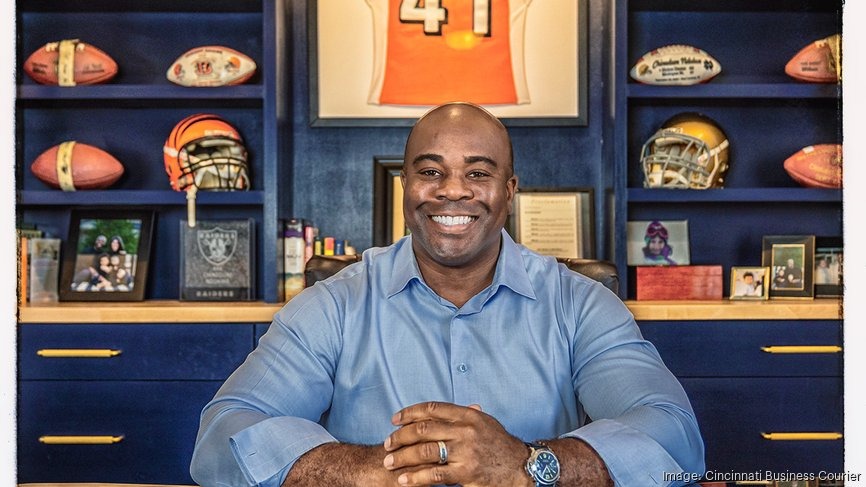
Chinedum Ndukwe built Kingsley and Company around that distinction. The Blair is one of its clearest expressions.
Design Choices as Mission Statements
In affordable housing development, design choices carry weight beyond aesthetics. The decision to build to a standard that exceeds minimum requirements — in materials, layout, amenity provision, and construction quality — signals something about the developer’s belief in the people who will live there. It signals that the residents of an affordable unit deserve the same quality of environment as residents of a market-rate unit, and that the developer is willing to absorb the cost of that belief.
That kind of decision does not emerge from a cost-optimization mentality. It emerges from a developer who has formed a view about what affordable housing should be — and who has the organizational capability and financial acumen to execute on that view without sacrificing project viability.
Ndukwe’s academic formation prepared him for exactly this balance. A double major in Business Management and Psychology from the University of Notre Dame, followed by programs at Harvard Business School and the Wharton School of Business, gave him both the financial modeling skills to make a rigorous project work and the human-centered perspective to ensure it works for the people inside it.
The Financing Architecture Behind Community-Centered Development
Building to a high standard in an affordable housing context requires financial creativity. Projects of this type rarely pencil with conventional financing alone. They require stacked capital structures — combinations of federal tax credit equity, community development lending, local housing authority programs, and conventional debt — assembled with precision and managed through a development timeline that leaves limited margin for error.
For a developer to make that structure work while maintaining quality standards, they must be rigorous at every stage: underwriting assumptions, construction budget management, leasing strategy, and long-term asset management. The gap between a project that demonstrates community-centered values and one that actually delivers them is filled with exactly this kind of operational discipline.
Kingsley and Company’s completion of The Blair is evidence of that discipline. The project was conceived, financed, built, and delivered — a full-cycle demonstration of what the firm is capable of.
What Completed Projects Signal to the Market
In commercial real estate, completed projects carry a different weight than announced projects. The development landscape is populated with proposals that did not advance, concepts that did not finance, and groundbreakings that preceded stalled construction. A completed project, delivered at the standard originally proposed, is a signal that a developer has the organizational maturity and financial capability to close the loop.
The Blair is that signal for Kingsley and Company. It demonstrates that the firm is not aspirationally community-centered — it is operationally community-centered. The distinction matters to every stakeholder who evaluates Kingsley and Company for future partnership: municipal development offices, housing authorities, lenders, and community organizations that need to know whether a developer will follow through.
Chinedum Ndukwe has built a firm where follow-through is the standard, not the exception. The Blair is the proof.
Projects as Civic Arguments
Affordable housing development, at its most intentional, is also a civic argument. It asserts that low-income residents deserve access to quality housing in neighborhoods where they want to live. It asserts that developers can build for those residents without sacrificing the financial discipline that makes projects sustainable. And it asserts that community-centered development and commercially viable development are not competing categories — they are the same category, done right.
Chinedum Ndukwe has been making that argument since founding Kingsley and Company. The Blair makes it in concrete and glass, in occupied units and established communities, in a way that any abstract statement of mission never could.
For a developer still building his track record in Cincinnati, that is the most persuasive argument available. And it is one he has already made.
About Chinedum Ndukwe
Chinedum Ndukwe is a Virginia native and University of Notre Dame graduate, where he earned a double major in Business Management and Psychology. He later completed programs at Harvard Business School and the Wharton School of Business at the University of Pennsylvania. Ndukwe is the founder of Kingsley and Company, a commercial real estate development firm with a focus on community-centered and affordable housing projects. His civic involvement includes service on the Mayor of Cincinnati’s task force for Immigration, the Notre Dame Athletics Monogram Board of Directors, and the Mercy Health Board of Directors. He is a licensed real estate agent specializing in real estate development.